Roof Pitch to Angle Converter – Formula, Steps & Example
Convert roof pitch (rise and run) into angle in degrees and slope percentage with our Roof Pitch to Angle Converter. Includes formulas, step-by-step calculation, and examples.
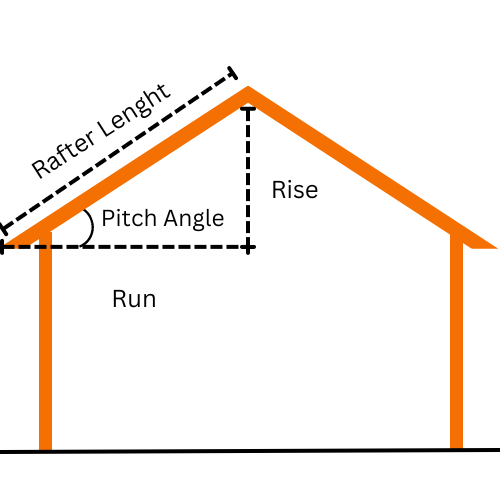
Understanding roof pitch is essential for construction, roofing design, and material estimation. With a Roof Pitch to Angle Converter, you can easily convert rise and run values into roof angle (degrees) and slope percentage.
This guide explains the formulas, calculations, and a practical example.
What is Roof Pitch?
Roof pitch describes how steep a roof is. It is usually written as a ratio:
Pitch = Rise : Run
- Rise = vertical height
- Run = horizontal length
Example: A 6:12 pitch means the roof rises 6 inches for every 12 inches horizontally.
Input Values
To use this calculator, you need:
- Roof Pitch (Rise)
- Roof Pitch (Run)
Output Values
The calculator provides:
- Roof Pitch (Ratio)
- Roof Angle (Degrees)
- Roof Slope (%)
Main Formula
The roof angle is calculated using the arctangent function:
Roof Slope Percentage Formula
Roof Pitch Ratio
Step-by-Step Calculation
- Enter rise and run
- Divide rise by run
- Apply inverse tangent (tan⁻¹) to get angle
- Multiply ratio by 100 to get slope %
Example Calculation
Given:
- Rise = 6
- Run = 12
Step 1: Calculate Ratio
Step 2: Calculate Roof Angle
Step 3: Calculate Slope Percentage
Final Result
- Roof Pitch = 6:12
- Roof Angle ≈ 26.57°
- Roof Slope = 50%
Why This Calculator is Useful
- Helps in roof design and planning
- Useful for contractors and DIY homeowners
- Assists in material estimation and safety calculations
- Required for building codes and structural planning